The Sound Window: How to Build a UK Festival Set That Peaks Before the Council Says So
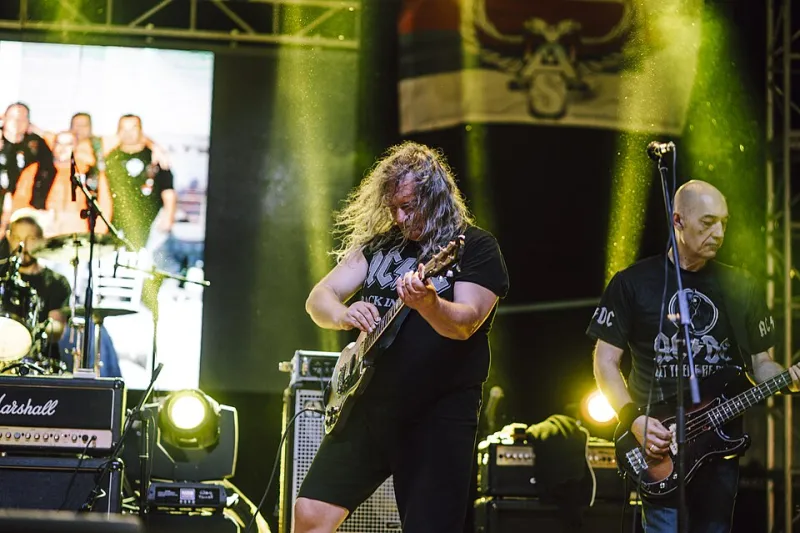
Photo: Shixart1985, CC BY 2.0, via Wikimedia Commons
There's a moment that happens at almost every UK festival, somewhere between 11pm and midnight. The crowd is finally warm, the tent is full, the sound desk has just got the room sitting perfectly — and then the PA goes quiet. Not a fade, not a wind-down. A cut. If you've never played Britain before, it can feel like the promoter pulled the plug out of spite. It wasn't the promoter. It was a piece of paper signed in a council chamber months earlier.
Understanding that piece of paper is one of the most useful bits of prep an international artist can do before a UK booking. Not because it's glamorous, but because the acts who understand it consistently look better on stage than the ones who don't.
What a curfew actually is (and isn't)
A UK festival's right to make noise is granted through licensing — usually a premises licence, sometimes a temporary event notice for smaller sites. Those documents come with conditions: a hard cut-off time for amplified music, a maximum sound level measured in decibels, a set of monitoring points at the edge of the site or in nearby residents' gardens, and a named person responsible for compliance. Environmental Health officers can and do turn up, meter in hand, and they're measuring an average level over a set period rather than a single spike.
So the curfew isn't the promoter being cautious. It's the promoter's legal ceiling. Breach it and the consequences range from a fine to losing a day of the licence next year — which is why nobody at the festival will bend it for you, however big your following is.
There's also a subtler layer: off-site noise limits. A stage can be perfectly compliant at the mixing desk and still breach at a farmhouse two kilometres downwind, especially when the wind shifts and the bass starts carrying. That's why some festivals quietly lower levels on certain stages as the night goes on, or why your sound engineer suddenly seems to be fighting the desk rather than helping you.
The questions to ask before you say yes
Most booking conversations between an international artist and a UK promoter consist of a fee, a date and a stage time. Push for a bit more. Ask, in writing:
- What is the exact curfew for my stage, and is it different from the site-wide one?
- Is there a sound level cap, and who monitors it — the festival's own engineer, or the council?
- What happens if the set runs over — is there a penalty clause, and does it fall on me or the promoter?
- Is there a soundcheck, or am I line-checking at 20 minutes before doors?
- Is there a hard-off at the desk, or will I get a warning light and a countdown?
That last one matters more than it sounds. Some festivals give you a five-minute warning and a gentle fade. Others simply mute the system at the appointed second. Knowing which you're walking into changes how you build the set.
Build the set backwards from the cut-off
Here's the mindset shift: the curfew isn't the end of your set, it's the start of your planning. Work backwards from the hard stop and mark out where your biggest moment needs to sit so it has room to breathe, land, and get a reaction before anyone's hand is on the fader.
In practice that usually means front-loading more than you would at home. If you're used to a slow-building 75-minute arc, a 45-minute UK festival slot with a strict finish wants your second-strongest track at around the 60 per cent mark, not the 85 per cent mark. Leave the final two minutes for something that can survive being cut short — a track with a clean ending, a vocal moment, a bow rather than a build.
And plan a false ending. If you know there's a chance the PA dies mid-song, don't let your closer be the one that needs a full four minutes of layering to make sense. Pick a finisher that still reads as a finisher if it's truncated, and rehearse a version of it that ends 90 seconds early.
Sound limits are an arrangement problem, not just a volume problem
When a stage is running close to its noise cap, the first thing that gets pulled down is sub-bass — it travels furthest and annoys the most people. If your set leans on low-end weight, that's the element most likely to be quietly removed from under you at 10:45pm.
So: bring a version that works without it. Know which parts of your tracks can be carried by mid-range, vocals and percussion. If you're playing with backing tracks, ask whether they can be split so the engineer can ride the low end independently rather than killing the whole thing. If you're fully live, think about which songs in the set would survive a thinner mix and place them where the levels are most likely to dip.
It's also worth asking about in-ear monitors. On a big outdoor site with a hard cap out front, the sound on stage and the sound in the field are two different worlds, and if you're mixing off what you can hear in the monitors you'll make bad decisions. IEMs let you keep your reference while the front-of-house engineer does what the licence requires.
The late-night workaround
If your set ends at 11pm and the site stays open until 3am, don't go to bed angry. Plenty of UK festivals now route their after-hours energy into spaces that aren't bound by the same amplified-music conditions: silent discos, small acoustic rooms, DJ sets in a licensed indoor venue, or a second stage with a lower cap that runs later.
Ask your promoter whether there's a late slot you could jump on — a 20-minute guest DJ set, a stripped-back acoustic turn, a host role. It's often the difference between a good booking and a booking that turns into three more. International artists who treat the after-hours as part of the job tend to be the ones the festival remembers in October when next year's budget lands.
Get the ending in writing
Before you sign, make sure the curfew and any penalties for overrunning are written into your agreement, and that the clock is defined — is it the stage time, the sound cut-off, or the point the site has to be clear? If a promoter refuses to put a curfew in writing, that's information too.
And if you do get cut off — it happens to headline acts, not just newcomers — don't take it out on the crew. The person who muted you is following a condition they can't override. Thank them, thank the crowd, post the clip. Nobody in the industry looks badly on an artist who handled a hard stop with grace, and plenty of people look badly on one who didn't.
The curfew is a creative constraint, and constraints are useful
Here at WEYA we talk to a lot of young artists about the gap between the set you've rehearsed and the set the room actually needs. A UK curfew forces that conversation early. It asks you to be decisive: what is this set for, what's the one thing the audience must leave with, and what can go?
The best festival performances in Britain aren't the ones that beat the clock. They're the ones that were designed knowing the clock was there — that hit their peak with two minutes to spare and left a field wanting more rather than a field watching a stage go dark mid-chorus. Learn the rules, plan around them, and you'll be the act that gets invited back to a site where the paperwork is already on your side.